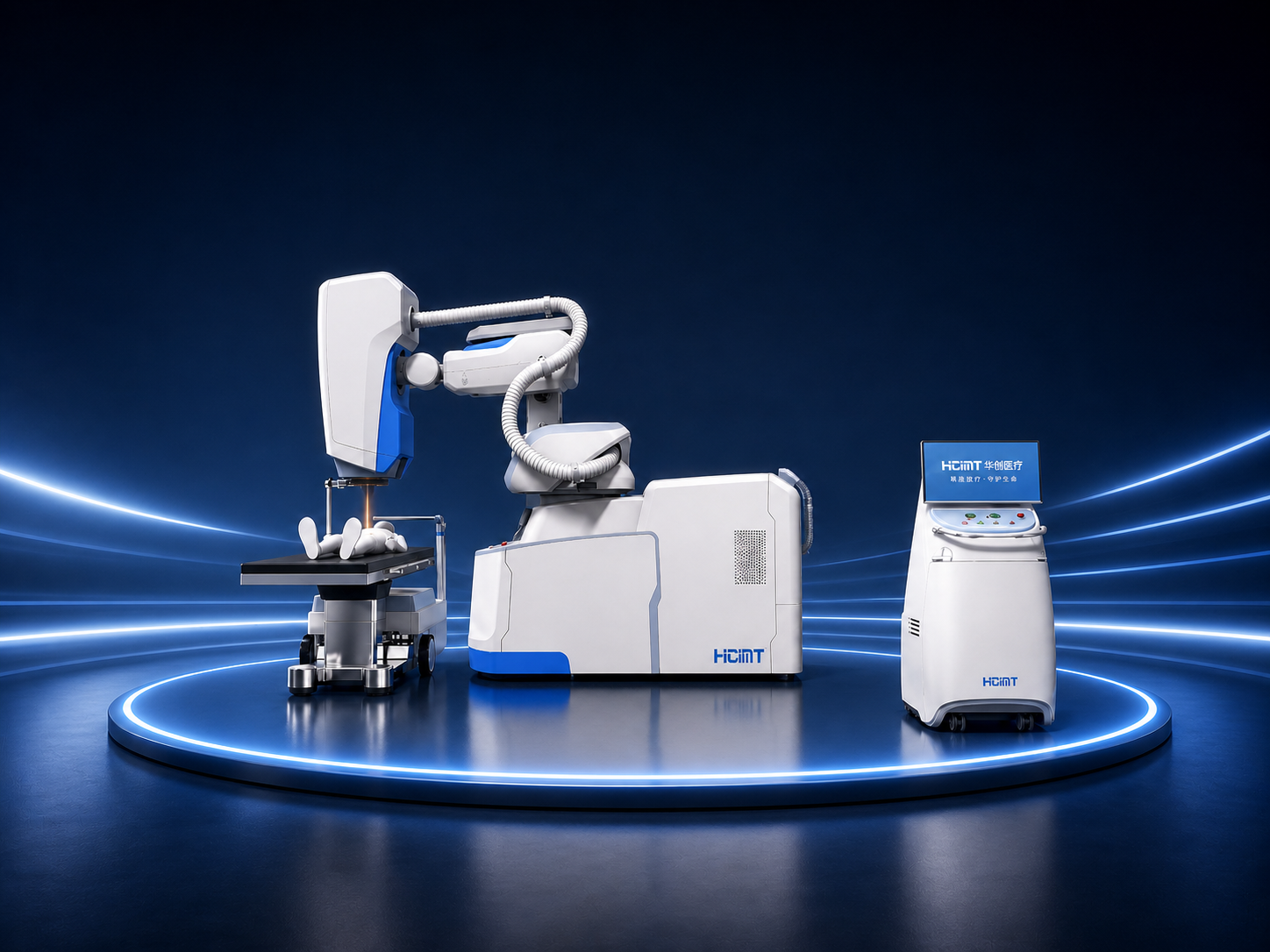
Rednet News, September 4 (Correspondents: Wu Fang and Yang Dong) — Recently, The First Affiliated Hospital of University of South China achieved an important technical breakthrough in oral cancer treatment by successfully applying Hunan’s first domestically developed mobile electron beam intraoperative radiotherapy (IORT) system in clinical care for oral cancer. This provides patients with a new, integrated treatment option combining surgery and precision radiotherapy. The hospital had already established the use of this technique in breast cancer, colorectal cancer and other cancers, accumulating extensive experience. Its successful extension to oral cancer further broadens the hospital’s IORT applications and advances its capabilities in precision cancer care.
The domestically developed mobile electron beam IORT system offers high precision, adaptability and safety. It supports three electron beam energies — 6 MeV, 9 MeV and 12 MeV — with a treatment depth range of 0–40 mm and a typical dose rate of 300–400 cGy/min. Available field sizes include 1 cm and 3–10 cm planar fields, as well as 4 mm and 10–50 mm spherical fields. Combined with automated soft docking and positioning, the system can deliver a single, precisely targeted high dose to the tumor bed immediately after tumor resection, effectively eliminating residual cancer cells while maximizing protection of surrounding normal tissues and organs and avoiding the drawbacks of conventional radiotherapy.
The patient treated with this new approach had high-risk oral cancer. Although the primary lesion in the oral cavity was small, there were multiple ipsilateral cervical lymph node metastases, with the largest node measuring 4 cm and lying immediately adjacent to the internal carotid artery and internal jugular vein. The risk of postoperative recurrence was high, and the prognosis with conventional surgery was limited.
To minimize recurrence risk and optimize treatment outcomes, the surgical team led by Deputy Director Lü Jie of the Department of Stomatology promptly convened a multidisciplinary team (MDT) consultation with the radiotherapy team led by Director Manbo Cai of the Department of Oncology, Associate Chief Physician Chen Lixun of the Department of Medical Imaging, Associate Chief Physician Yang Shuai of the Department of Pathology and other specialists. Following careful assessment, the team developed an individualized combined treatment plan of wide excision of the lesions followed by precision IORT.
During surgery, the medical team first completely removed the primary oral tumor and the metastatic lesions in the neck. To address the risk of high-dose radiation damaging nearby nerves, the surgical and radiotherapy teams worked closely together to fully mobilize the nerves adjacent to blood vessels within the irradiation field and carefully shield them with lead tubing and lead sheets. This enabled targeted high-dose irradiation of the tumor bed under direct visualization to precisely eliminate potential residual disease while safeguarding normal tissues.
From conventional radiotherapy to targeted tumor clearance with IORT, and from breast and colorectal cancers to oral cancer, the hospital’s team has consistently used technological innovation to advance cancer care. The successful application of IORT to oral cancer demonstrates the hospital’s core capabilities and innovation in precision oncology as a regional medical center, helping fulfill its commitment to enabling patients with serious illnesses to receive care within Hunan. The hospital will continue to advance cutting-edge medical technologies and pursue clinical excellence, translating high-quality, precise care into health benefits for people across the province.